Organic Sunscreen: Choosing Simpler Sun Protection Without Unwanted Chemical Exposure
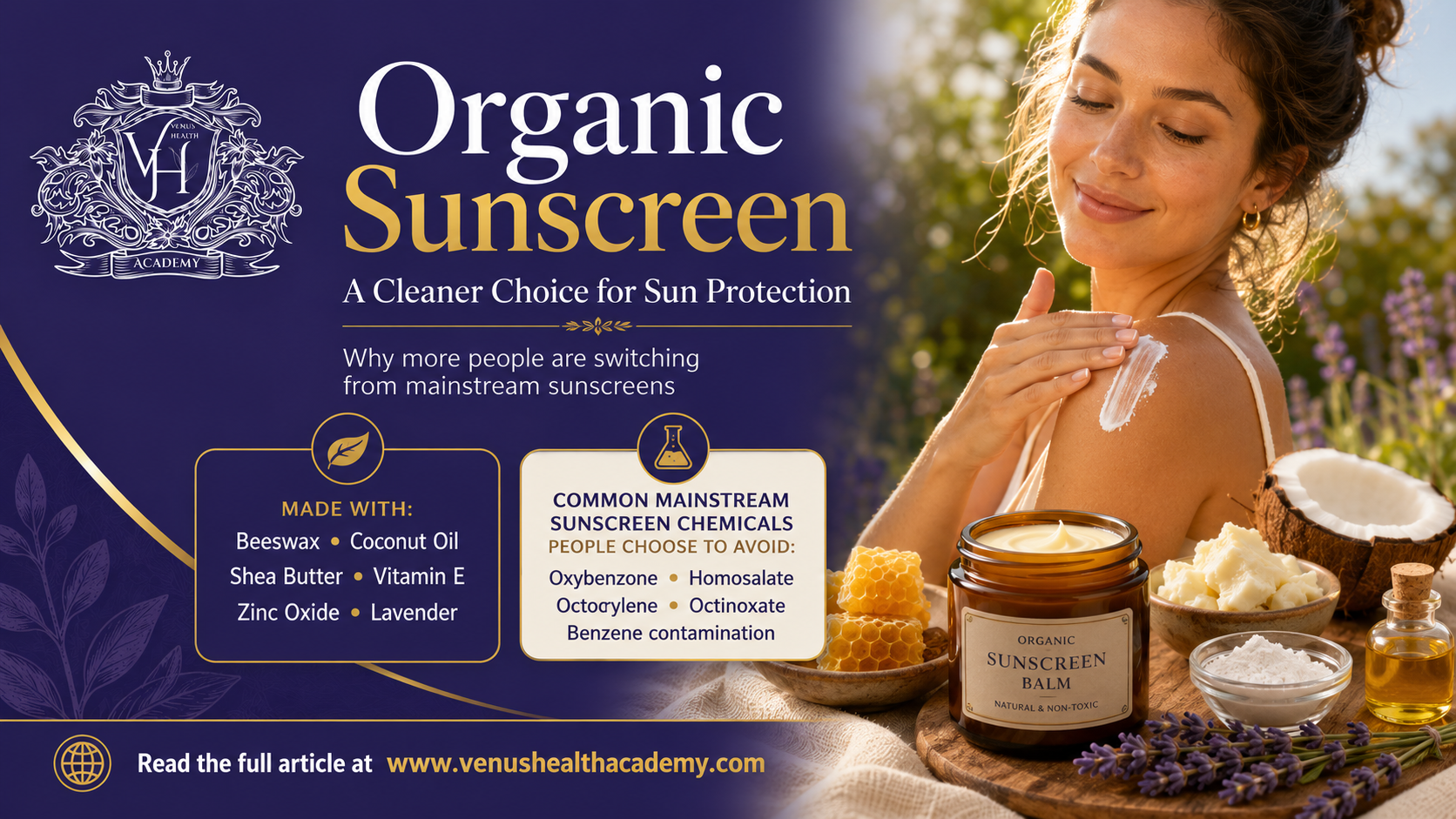
Many people are becoming more conscious of what they apply to their skin and are looking beyond mainstream sunscreens containing ingredients such as oxybenzone, homosalate, octocrylene and octinoxate. Discover a simpler organic sunscreen made with zinc oxide, raw coconut oil, shea butter, beeswax, vitamin E and lavender oil.
For many years, consumers have been encouraged to apply sunscreen generously without paying close attention to the ingredients contained within the bottle. As awareness grows around cosmetic ingredients, hormone-disrupting substances, chemical absorption and product contamination, more people are beginning to question whether every mainstream sunscreen is the best choice for their skin.
Sun protection remains important, but protecting the skin should not require exposing it to an unnecessarily complicated mixture of synthetic filters, fragrances and chemical additives. This is why many health-conscious consumers are turning towards mineral-based, organic sunscreen formulations made with familiar, carefully selected ingredients.
The concern about benzene in sunscreen
One of the most serious concerns associated with certain mainstream sunscreen products has been the discovery of benzene in recalled aerosol sunscreen batches.
Benzene is classified as a human carcinogen. It has been linked to blood cancers and other serious effects following sufficient exposure. The International Agency for Research on Cancer has formally evaluated benzene as carcinogenic to humans.
Benzene is not supposed to be an active sunscreen ingredient. Nevertheless, FDA-listed recalls have involved aerosol sunscreen products from well-known brands after testing detected benzene contamination. Recalled products have included particular batches or ranges sold under brands such as Neutrogena, Aveeno, Banana Boat and Coppertone.
This does not mean that every mainstream sunscreen contains benzene. It does, however, demonstrate why ingredient transparency, careful manufacturing and informed consumer choice matter. It also gives people a valid reason to prefer simple creams and balms over aerosol products when they want to reduce unnecessary exposure.
Oxybenzone or benzophenone-3
Oxybenzone, also listed as benzophenone-3 or BP-3, is a chemical ultraviolet filter used in some conventional sunscreens.
Concerns surrounding oxybenzone include its absorption into the body and its potential endocrine activity. Following a safety assessment, the European Scientific Committee on Consumer Safety concluded that oxybenzone at 6% was not safe for use in body sunscreen creams and sprays, recommending substantially lower concentrations for those products.
The United Kingdom has now introduced tighter restrictions on oxybenzone because of a potential risk to human health. The regulations limit the permitted concentration according to the type of cosmetic product in which it is used.
Consumers wishing to avoid oxybenzone should look for the following names on product labels:
Oxybenzone, benzophenone-3, BP-3 or 2-hydroxy-4-methoxybenzophenone.
Homosalate
Homosalate is another synthetic UV filter commonly included in mainstream sunscreen formulations.
It has been examined because of concerns relating to possible endocrine-disrupting properties. The European Scientific Committee on Consumer Safety concluded that homosalate could not be considered safe when used at a concentration of 10% across cosmetic sunscreen products. The committee’s assessment supported much lower or more restricted levels of use.
The concerns examined have included possible effects involving hormonal, reproductive and thyroid-related pathways. Although the evidence concerning specific endocrine effects continues to be evaluated, the decision to restrict acceptable concentrations is one reason many consumers prefer a sunscreen without homosalate.
Look for the name homosalate in the active-ingredient section of the label.
Octocrylene and benzophenone formation
Octocrylene is used to absorb ultraviolet radiation and to help stabilise other sunscreen filters. However, it has attracted attention because it can contain or produce benzophenone as an impurity or degradation product.
The European Scientific Committee on Consumer Safety describes benzophenone as a hazardous impurity and degradation product of octocrylene that should be monitored and kept at trace levels. The committee has also considered reports of contact sensitivity and photoallergy associated with octocrylene.
This is particularly relevant to products that may have been stored for long periods or repeatedly exposed to heat. Consumers choosing simpler mineral formulations can avoid both octocrylene and concerns about its degradation products.
Look for octocrylene on the ingredients label.
Octinoxate
Octinoxate may also appear under the names ethylhexyl methoxycinnamate, octyl methoxycinnamate, EHMC or OMC.
A recent European safety evaluation identified octinoxate as an endocrine-active substance, demonstrating oestrogenic and weak anti-androgenic activity in the evidence reviewed. The committee nevertheless concluded that it remained within the accepted safety margin at authorised concentrations of up to 10%.
This distinction is important: endocrine activity does not automatically mean that an ingredient has been proven to cause cancer in people. However, consumers who follow a precautionary, low-toxin approach may still prefer to avoid it, particularly when mineral alternatives are available.
Fragrance and unnecessary additives
Many conventional sunscreens also contain added perfume or fragrance mixtures. These are not automatically carcinogenic, but they can be unnecessary for people who want a straightforward sun-care formula.
A long ingredients list may also contain stabilisers, texture modifiers, preservatives, solvents and colourants. Each ingredient serves a manufacturing purpose, but a growing number of consumers simply prefer products containing fewer ingredients they can easily recognise.
What makes this organic sunscreen different?
This Venus Health Academy organic sunscreen is centred on zinc oxide, a recognised mineral sunscreen active ingredient. Zinc oxide is included among the permitted sunscreen active ingredients in the FDA sunscreen monograph.
The formula combines:
Natural beeswax
Raw, unrefined coconut oil
Shea butter
Vitamin E oil
Zinc oxide
Lavender oil
Rather than relying on oxybenzone, homosalate, octocrylene or octinoxate, the formulation uses zinc oxide as its mineral ultraviolet filter. The coconut oil, shea butter and vitamin E create a rich, nourishing base, while beeswax gives the sunscreen its protective balm-like consistency. Lavender oil completes the formulation with its distinctive natural aroma.
A more conscious approach to sun care
Choosing an organic, mineral-based sunscreen is about more than following a trend. It is about becoming informed about what is applied to the skin and selecting products that reflect your personal values.
The most accurate concern is that benzene is a confirmed human carcinogen that has been detected as contamination in certain recalled sunscreen products. Other ingredients—including oxybenzone, homosalate, octocrylene and octinoxate—are better described as chemical filters associated with regulatory restrictions, endocrine concerns, sensitivity or potentially hazardous degradation products rather than all being proven human carcinogens.
For consumers seeking a simple alternative, this organic sunscreen offers a transparent formulation made from six carefully selected ingredients. It allows people to enjoy the outdoors while choosing a product that avoids several of the synthetic sunscreen filters commonly found in mainstream formulations.
References
www.fda.gov/safety/recalls-market-withdrawals-safety-alerts/johnson-johnson-consumer-inc-issues-voluntary-recall-specific-neutrogenar-and-aveenor-aerosol — FDA recall of specific Neutrogena and Aveeno aerosol sunscreens following the detection of benzene.
www.publications.iarc.who.int/Book-And-Report-Series/Iarc-Monographs-On-The-Identification-Of-Carcinogenic-Hazards-To-Humans/Benzene-2018 — International Agency for Research on Cancer monograph evaluating the carcinogenicity of benzene.
www.health.ec.europa.eu/document/download/5488f129-dd92-42fc-b7f5-21e1ac37ef3d_en?filename=sccs_o_247.pdf — European Scientific Committee on Consumer Safety opinion on oxybenzone, also known as benzophenone-3.
www.legislation.gov.uk/uksi/2025/901 — UK regulations restricting the permitted concentrations of oxybenzone in cosmetic products because of potential risks to human health.
www.health.ec.europa.eu/system/files/2022-08/sccs_o_244.pdf — European Scientific Committee on Consumer Safety opinion on homosalate and concerns relating to its potential endocrine-disrupting properties.
www.health.ec.europa.eu/document/download/2928185b-f8b7-474e-937a-052a90a90970_en?filename=sccs_o_249.pdf — European Scientific Committee on Consumer Safety opinion on octocrylene, including discussion of benzophenone as an impurity and degradation product.
www.health.ec.europa.eu/document/download/3166a978-06de-4526-b25e-8d5a66943a2e_en?filename=sccs_o_294.pdf — European Scientific Committee on Consumer Safety opinion on ethylhexyl methoxycinnamate, also known as octinoxate or octyl methoxycinnamate.
www.accessdata.fda.gov/drugsatfda_docs/omuf/monographs/OTCMonograph_M020-SunscreenDrugProductsforOTCHumanUse09242021.pdf — FDA sunscreen monograph listing permitted sunscreen active ingredients, including zinc oxide.
www.accessdata.fda.gov/scripts/cder/omuf/index.cfm?event=monographsearch&val=Sulisobenzone — FDA database for over-the-counter sunscreen active ingredients, including zinc oxide, oxybenzone, homosalate, octocrylene and octinoxate.